The Oregon Trail
The 1990 MECC release most adults mean when they say 'Oregon Trail.' Pick a profession, load a wagon, and cover 2,170 miles to Oregon City without burying the whole family along the way.
What is The Oregon Trail game?
The Oregon Trail is an educational strategy game about leading a covered wagon across the American frontier. You take a small party out of Independence, Missouri and try to get them to the Willamette Valley in Oregon, about 2,170 miles, and the game's whole job is to make that trip hard in the specific ways it was hard for the people who actually made it between 1841 and 1869. You pick up plenty of history and geography on the way, but mostly it teaches you to decide things without enough information.
The 1990 version is set in 1848. You buy supplies, ration the food, set a pace, and then spend the rest of the run reacting to whatever the trail does to you next: a broken axle, a sick child, a river running high. There is no trick to it and no difficulty slider that makes the bad events stop. That is exactly why it worked in classrooms. A kid who lost the whole wagon party learned more in five minutes than a worksheet managed in a week.
Where the game came from
The Oregon Trail started as a classroom assignment, not a product. In 1971 three student teachers in Minnesota (Don Rawitsch, Bill Heinemann, and Paul Dillenberger) wrote it in BASIC for an eighth-grade history class, on an HP 2100 minicomputer. It nearly ended there. When the term finished Rawitsch held onto the code, and in 1974 he carried it with him to the Minnesota Educational Computing Consortium (MECC), which put it on the state's school time-sharing network in 1975 and watched it turn into one of the most-used programs Minnesota schools had.
From there it kept getting rebuilt. R. Philip Bouchard led a graphical remake for the Apple II in 1985, and the 1990 MS-DOS and Macintosh release (the one preserved on this page) is the version most adults picture when they think of the game. It was also the point where MECC stopped being a mainframe outfit and started shipping software for the computers in people's homes.
The redesign that stuck
The 1990 release didn't appear out of nowhere. It grew straight out of the 1985 Apple II edition, which a small MECC team built over roughly ten months across 1984 and 1985 with R. Philip Bouchard leading the design. That was one of the first educational games to reach a wide audience, and it set a bar the genre still gets held to.
Every version since 1971 has changed the surface and left the core alone. Text on a teletype in 1971, color graphics on the Apple II in 1985, the DOS and Mac rewrite in 1990, the VGA polish of Deluxe in 1992, the ground-up Oregon Trail II in 1995. They all come down to the same handful of verbs: Buy a wagon, pick a pace, ration the food, get across the rivers, reach Oregon if you can. The franchise has since sold more than 65 million copies, and in 2016 it was inducted into the World Video Game Hall of Fame.
Nobody set out to build a classic. They built a history lesson that happened to be unforgiving, and the unforgiving part is what stuck.
The journey
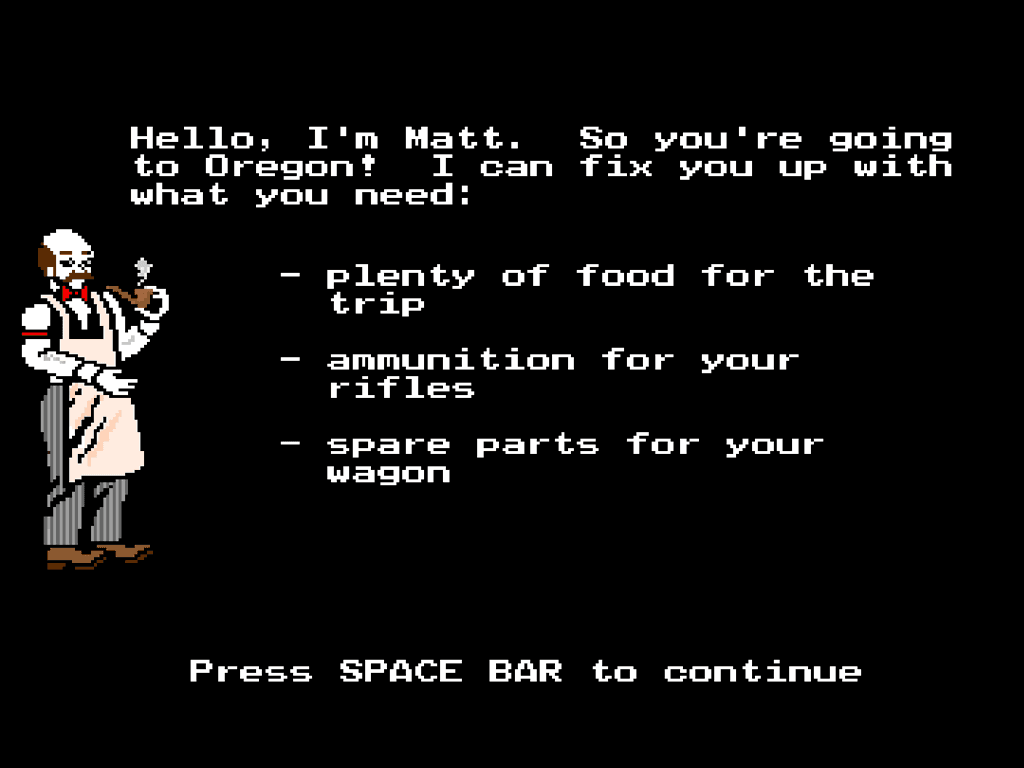
Every run opens on the same screen of choices. First the profession: a banker starts with the most money and the easiest game, a farmer starts with the least but scores highest, and a carpenter sits in between. Then you name yourself and the four people traveling with you. Naming them after your actual friends is a tradition for a reason, because some of them are not going to make it. After that you walk into Matt's General Store in Independence and spend what you have on oxen, food, clothing, ammunition, and spare parts for the wagon.
The trail runs in sixteen legs, and each one ends at a landmark you'll recognize from any map of the real route: Fort Kearney, Chimney Rock, Fort Laramie, Independence Rock, South Pass, Fort Hall, Fort Boise, the Blue Mountains, the Dalles, Oregon City. A landmark is where you catch your breath. You can trade, restock, talk to whoever else is passing through, or stand at the water and decide how to get the wagon across: ford it, caulk it and float, pay for a ferry, or, late in the game, gamble on the Columbia raft.
Two things make the start matter more than it looks. Prices go up the further west you get, so the cheap supplies are the ones you skip back in Independence. And there is no saving and retrying mid-journey. A run is one unbroken line of decisions from the store to the valley. Get the outfit wrong and you can lose the whole thing six weeks later to a problem you can trace straight back to the counter. That is the part students remember: for a lot of them it was the first game that simply would not let them off the hook.
Surviving the trail
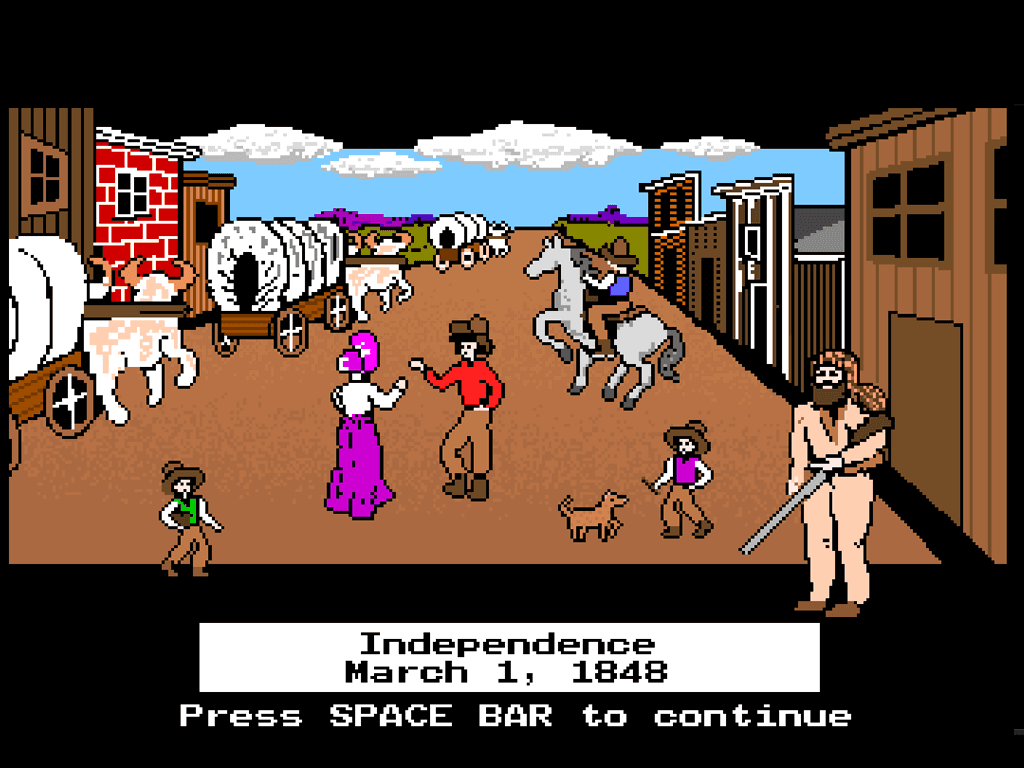
Between landmarks the game gives you one plain status panel: the date, the weather, how everyone is holding up, how much food is left, how far there is still to go. Then it starts throwing things at you. A wagon tongue snaps. One of the kids comes down with measles. A thief makes off with a yoke of oxen overnight. A buffalo herd wanders past. Your tools against all of it are blunt: how much everyone eats each day (filling, meager, or bare-bones), how hard you push the pace, and whether you stop to rest when someone is ill.
Hunting is the one part that plays like an arcade game. When food runs low you head out with whatever ammunition you have been hoarding and shoot at deer, rabbit, bison, and bear. Work the same patch of country too often, though, and the animals stop showing up. A run ends one of two ways: you reach the Willamette Valley, or the last person in your party dies. The game keeps a long list of ways for that to happen: cholera, dysentery, typhoid, drowning, snakebite, a bad fall.
Your final score adds all of it up: who lived, what money and supplies you arrived with, how hard a profession you picked, and how fast you got there. That is the hook that keeps people coming back. There is always a better number sitting just out of reach, and a clean farmer run with all five travelers still alive is genuinely tough to beat.
Play The Oregon Trail online
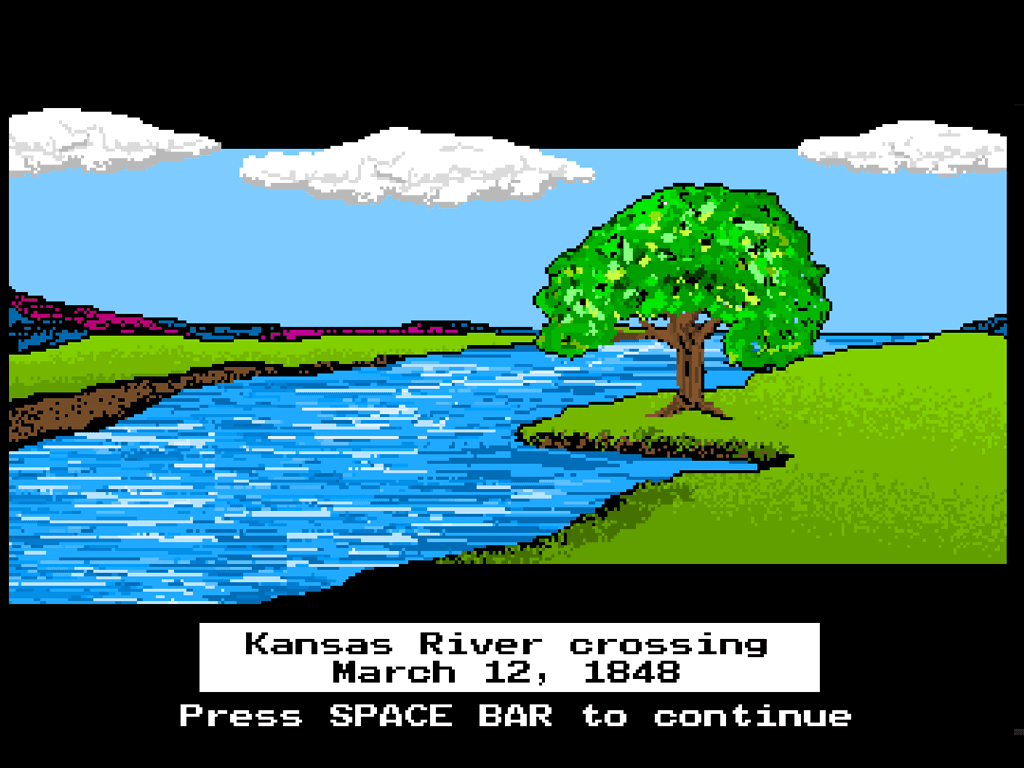
You can play the 1990 Oregon Trail right here in the browser. It is preserved from an Internet Archive software collection and runs through an embedded DOSBox emulator, so there is nothing to download, nothing to install, and no account to make. It works on a desktop and on most current mobile browsers. On a phone the on-screen keyboard handles the name and number prompts, and the emulator's full keyboard is there when you need it.
What you see is the 1990 game at its original resolution, the same chunky 16-color art that ran on the 386 and 486 machines in school computer labs. We have left it that way on purpose. Cleaning up the graphics would smooth out the exact thing that makes this feel like a record of its time instead of a remake of it.
The mark it left
For a lot of people the Oregon Trail was not just an early video game, it was the first one, full stop. It ran in American school computer labs straight through the 1980s and 1990s, which means millions of kids met video games by way of a covered wagon. It left phrases behind, too. 'You have died of dysentery,' the line the tombstone screen prints when your health runs out, has outlived the hardware it was written for and turned into a joke people still make whether or not they have ever played. South Park built a whole episode around it in 2010: the season 14 episode 'Pioneers,' where the boys get trapped inside a glitching copy and have to play their way out. And the kids who grew up on those classroom Apple IIs and DOS labs, late Gen X and the oldest millennials, ended up with a name for themselves: the Oregon Trail Generation.
The honors came later. In 2016 the franchise was inducted into the World Video Game Hall of Fame at The Strong National Museum of Play in Rochester, New York, in the same class as Pac-Man, Doom, and Super Mario Bros. It was the only educational title to make that first group. That same year Time ranked The Oregon Trail #9 on its 50 Best Video Games of All Time, crediting it as the game that showed American students history could be something you did rather than something you memorized. Counted across every edition, the franchise has sold more than 65 million copies, a number nothing else in educational gaming comes near. By 1995 it was bringing in about a third of MECC's revenue on its own.
The 1990 release is the one historians and players keep returning to, and it is the one preserved here as it shipped. It is a plain game and a hard one, and it is honest about the journey it puts you through in a way that still catches people off guard.
Why it still holds up
None of this would matter if the game itself had aged badly, and the surprising thing is that it hasn't, not really. A small team in Minnesota decided the way to teach kids about a wagon journey was to make them take one, and that idea still works thirty-five years on. The history, the tight supply math, the low hum of dread before each new event screen, and it all still pulls.
If you played it as a kid, it will come back faster than you expect. If you never did and just want to see what everyone is on about, the 1990 release is the right place to start, because it is the version the memories are actually about. Pick a profession, load the wagon, and head west.
Notable systems
- 5 professions with money/score multipliers
- 9 starting months × pace × ration permutations
- Hunting minigame, river fording, fort resupply
- Talking heads from townspeople along the way
- Tombstone messages persisted to disk